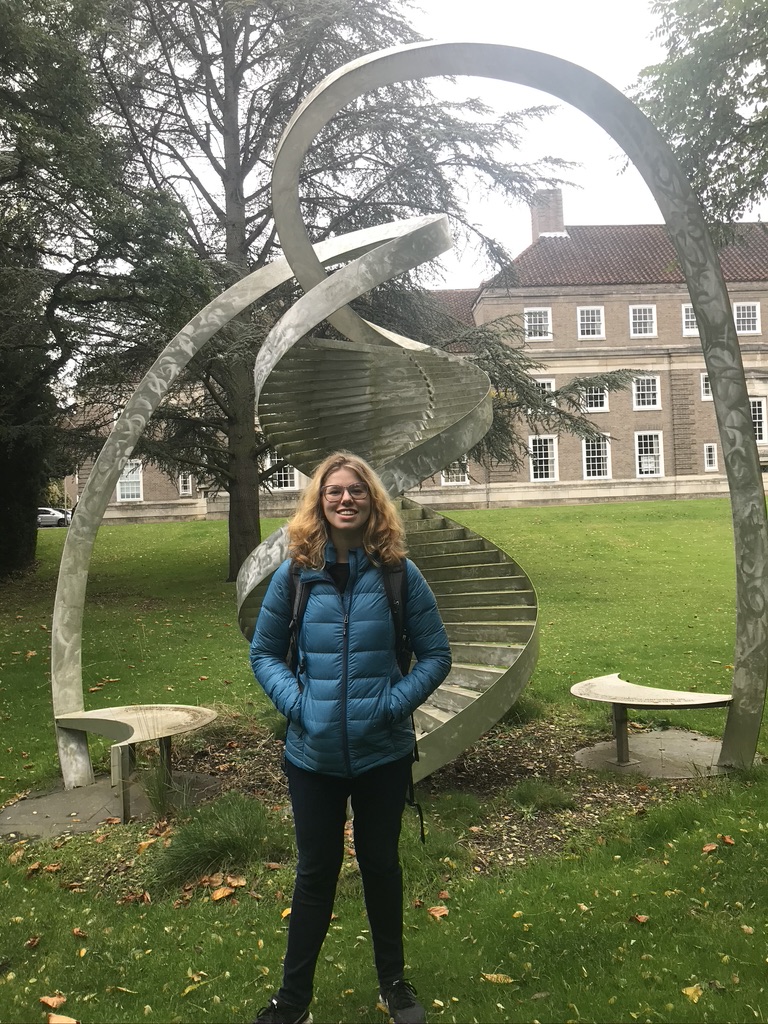
Part of the AQLab at the Program for Mathematical Genomics, where the group constructs a foundational, whole-genome language model. My focus is on evaluating these models and applying them in novel ways, especially to microbes.
Education
PhD, Systems BiologyColumbia — ongoing
MSc, BiologyTechnion Institute — 2021
BSc, NeuroscienceMcGill — 2019
Recognition
Open Philanthropy Early Career Funding recipient. Gutwirth Memorial Fellowship for Excellence in Research for harnessing novel genomic approaches and big data to investigate how bacterial pathogens evolve upon recurring infections (Kishony Lab, Technion).
Research
Publications
Hover to read the abstract, click through to the full paper.
SSRN Preprint
Managing the Transition to Widespread Metagenomic Monitoring
C Liang, J Wagstaff, V Schmit, N Aharony, D Manheim
2022
Hover for abstract
Abstract
Despite extensive discussion of the technological possibilities and public health importance of metagenomic sequencing, there has been scant discussion of what policy and regulatory issues need to be addressed. We review the current state of biosurveillance, highlight key policy challenges, and find that policymakers must address pitfalls like fragmentation of the technological base, privacy concerns, and how future systems will enable better response.
Community-Level Evidence for SARS-CoV-2 Vaccine Protection of Unvaccinated Individuals
O Milman, I Yelin, N Aharony, R Katz, E Herzel, A Ben-Tov, J Kuint, S Gazit, G Chodick, T Patalon
2021
Hover for abstract
Abstract
Community-level analysis of BNT162b2 vaccine rollout in Israel showing that vaccination of a substantial proportion of the population provides measurable protection to the remaining unvaccinated individuals, providing evidence for herd-immunity effects of COVID-19 vaccination at the community scale.
Evaluation of COVID-19 RT-qPCR Test in Multi-Sample Pools
I Yelin, N Aharony, E Shaer Tamar, A Argoetti, E Messer, D Berenbaum, E Shafran, A Kuzli, N Gandali, O Shkedi, T Hashimshony, Y Mandel-Gutfreund, M Halberthal, Y Geffen, M Szwarcwort-Cohen, R Kishony
2020
Hover for abstract
Abstract
A single positive sample can be detected in pools of up to 32 samples, using standard kits and protocols, with an estimated false negative rate of 10%. As it uses standard protocols, reagents and equipment, this pooling method can be applied immediately in clinical testing laboratories, enabling the expansion of COVID-19 detection in the community.
Adeno-Associated Viral Vectors for Homology-Directed Generation of CAR-T Cells
PD Moço, N Aharony, A Kamen
2019
Hover for abstract
Abstract
We review recent efforts to develop safer universal CAR-T cells, focusing on the combined application of target-directed nucleases (which create double-strand breaks at specific genome loci) and adeno-associated viral vectors for subsequent CAR integration via homologous recombination, simultaneously silencing the targeted gene to enable allogeneic therapy.
On the gap between what science funding incentivizes and what makes research interesting.
What not to ask a scientist
In the last year of my neuroscience degree, I sat in a guest lecture by one of the department's newly-recruited professor. His lab explored the signalling molecules that orchestrated the very detailed, fine-tuned process of wiring the brain to the eye. It was an intimate seminar where he talked about the process of becoming a scientist and why he chose his area of research. At one point, one of the students raised their hand.
"what's the use of your research?" he asked.
"I don't understand the question," said the new professor. "do you want to know what I write in my grant application, or what I believe?"
He went on to explain that in his grant applications, he writes some BS about a genetic disease associated with the area he researches, but in reality, his research has no use. Its only use is the joy and interest it sparks in him (and hopefully his students, employees, and colleagues). Surely there is a slight chance it will amount to a future all-encompassing theory that is valuable and has applications, but that is still relatively rare.
A chimera of basic and clinical science
I think that is a well-known fact among scientists, especially those who do unquestionably basic research. But my guess is that it is not well-understood by grantmakers, since despite the fact that most research (even a large part of clinical research) is well-understood by its conductor to probably amount to nothing, it keeps getting funded.
This was actually incredibly frustrating to me as an undergrad (and a naïve one at that) since multiple times I would come to a lab that I believed (as the grantmakers do) does important, valuable work only to realize upon closer examination that the argument connecting it to any real-world problems is built on strings and matches.
I think that what frustrated me most in this whole ordeal is that oftentimes what was studied in the lab was just not interesting on its own. I think this issue is more common in second-tier universities but essentially, a researcher who wants to pursue a truly basic science ends up pursuing a more 'watered-down' version of their dreams in order to keep getting funded.
Of course there are other reasons why the majority of research I saw out there just didn't seem interesting enough to me – maybe I'm just not that curious a person. Maybe we just don't have the technological tools to ask enough interesting questions for the number of research labs that exist in the world today. In addition, I think that constructing experiments that get at the heart of interesting questions is an incredibly hard task – maybe that is why so much of research ends up being boring.
But in the end of the day most scientists are constrained to the areas for which they can get funding, many labs are constrained by the amount of funding they get, and a lot of the grants do require the scientists to pursue specific projects with 'real-world-applications.' Grantmakers are often interested in improving the world more than the scientists do, with a clear reason – the money often is given by outside stakeholders, there are very few stakeholders who donate to science as a means to an end.
So much of the research labs I came into contact within my undergrad were somewhere on that line – they were poorly funded and pursued overly-specific questions. So much of the dissatisfaction I saw among grad students seemed to come from this – they never really got the opportunity to explore something interesting and engaging, they never got the opportunity to truly self-actualize as scientists.
A plea in the name of basic research
A few months ago, I had the privilege to sit in a lecture by Emmanuelle Charpentier about the discovery of CRISPR-Cas9. Dr. Charpentier spent much of the lecture paying homage to all the discoveries (and discoverers) that had to be made in a field for CRISPR to be made possible. CRISPR is a unique example because though the research right now is very application-driven and is dominating a large part of the field, it began as the very basic of researches – the study of the bacteria immune system in response to phage, two organisms whose majority was not even pathogenic or had anything to do with humans. Dr. Charpentier, the only truly basic scientist out of the discoverers of CRISPR (the others fall more easily into the category of bioengineers or synthetic biologists) stressed the need to fund basic sciences in order to continue making these types of world-changing discoveries.
I wish there was more funding for basic research. Sure, there is plenty of space for truly clinical research and oftentimes there needs to be some in-between research that connects the theoretical to the clinical, but I think focusing on an application even in basic research creates reductive, myopic research that may have a higher likelihood to be applied in the short term but is less likely to create those few disrupting discoveries or novel, encompassing new theories. It also forces professors to lie on their grant applications.
My experience as a student
I feel like the ubiquity of this research has made me aimless for a long time. I was very frustrated as an undergrad. I ended up drifting between 5 different research groups before finding an area of research where I didn't feel like I have to suspend my critical thinking in order to believe in the validity of my results.
Now I am researching the genetic changes among recurring urinary tract infections and I can go on and on about why this is so perfect and essentially the epitome of what I believe science is. In a way, it is a clinical pursuit – the samples I work with were isolated from people, but I think that I am still satisfied because I see the connection to the clinic as a means to an end – I am using a phenomenon in the clinic in order to uncover patterns that can be generalized to evolution as a whole to a certain extent.
I also feel that in my current lab, where the focus is more on theory and asking questions that are interesting on their own, we end up using a larger range of tools and more cutting-edge technology to answer these questions. Overall, it gives me a better training as a scientist that I would have gotten in a lab where the questions researched would have had stronger ties to the clinic.
By incentivising scientists to pursue research with short-sighted applications, we are sabotaging ourselves. We are slowing down progress in fields that are extremely engaging and train people better. Supporting basic research is not only investing in those future theoretical discoveries, like the next CRISPR. It also trains better students.
Mar 2020
Optimal Lethality
On the popular idea that viruses evolve to be less lethal — and why it's more complicated.
I had this argument with my aunt, who said that one of the reasons we shouldn't worry as much about COVID-19, is that viruses evolve to be less lethal over time, and she said that this is what happened with H1N1.
I've only been studying evolution for a few months, and in bacteria, not viruses. But this short timeframe gave me a hunch that this idea is just too elegant to be true. In expansion, this theory would be that viruses have an optimal level of fatality, after which they kill their host too quickly to spread efficiently through the population.
This idea sounds elegant but the reality of genetics is just a lot more messy. First of all, it's really hard to make a statement that generalizes to all viruses' evolution. There are just too many and they're too different. Second, genes don't translate directly to human concepts. Viruses don't really have a gene for severity and a gene for transmissibility, it's all a lot more jumbled up. A gene can affect transmissibility AND severity, or a whole lot of other things.
So I looked into H1N1 and what I found was very supportive of the claim. H1N1, it seems, became more lethal after the WHO declared it pandemic. When researchers infected ferrets (who for some reason have a similar system to humans) the additional mutations seemed to increase the rate of replication in the respiratory tract, which increased transmissibility, but also severity!
So my aunt was wrong about H1N1 (which is both encouraging and discouraging at once), but I wanted to see if there's still any pattern that can generalize for other viruses. If that was the case, 1) it'd make me even more scared about COVID-19 and 2) it'd be very evolutionarily beautiful and elegant.
But luckily I found a really cool counter-example: HIV. Apparently, following infection it adapts over time towards a less virulent form. There are a few theories as to why exactly (with antiretroviral therapy and adaptation to avoid the immune system being two), but the article also suggests my aunt's exact theory, that evolution favours milder symptoms. So I can tell my aunt we were both right.
All this comes to show that our understanding of evolution and genetics is still too limited to paint with a broad brush. It's very difficult to predict the evolution or traits of a virus, especially one that just now emerged.
Jan 2020
When Less Is More?
On why minimal media may actually help grow more diverse microbial communities.
For my graduate project I am trying to grow a community of microbes together. The main problem I'm facing is that putting many species together is not a guarantee they will survive, some will go "extinct" in my experiment. To do that, two different postdoctoral students advised me to use a minimal and defined media, like M9 with glucose, since this forces the different species to interact. But eliminating resources to increase diversity seemed counterintuitive to me. For instance, what is more diverse? The resource- and water-rich Amazon forest, or the desert?
I came up with 3 possible explanations why minimal media are actually used to grow microbial communities: (1) A minimal media does lead to more community diversity, by forcing microbes to interact rather than compete. (2) A minimal medium slows down fast-growing bacteria enough to see slow-growing bacteria. (3) Well-defined mediums are a good "control" for microbial ecology, and defined mediums tend to be minimal media.
I would think that this essentially creates a "rich gets richer" principle. Any excretion essentially creates a new metabolite a new species can feast on. That species in return excretes a different metabolite, which then opens the niche for another species to consume it and excrete another metabolite. More microbes enrich the environment, which in turn invite more microbes.
This paper makes two important points. One, that a minimal media does force interaction between species (in the form of relying on one another's metabolites) and two, that it does allow a more diverse community than initially predicted. However, it doesn't prove that a poor media would create a more diverse community than a rich media.
But then, there might be a different reason why I specifically should use a minimal media. The reason is that I don't want to grow my community, I also want to evolve it. At least according to "Structure and Evolution of Streptomyces Interaction Networks in Soil and In Silico" more interactions increases the rate of evolution in an organism.
There is also a way to experimentally test which media is best for communities. I can grow my communities on an M9 media with one measure of glucose versus 5 times the glucose, and I can grow them on LB media at the normal amount versus 1/5 of the amount. But then I also start getting into trouble.
For instance, am I not just comparing M9 to LB? Maybe I should use a larger diversity of media? Also, which community should I use? From the sea, the soil, sewage, or my stomach? What about extremophiles?
It's very hard to make such a universal statement in microbial evolution. A more realistic solution will probably be a simulation.